
2026-09-22
3D Printing Materials
3D Printing has come a long way over the years and so has your material that you use to print with. Each material has its own characteristics, advantages and applications.
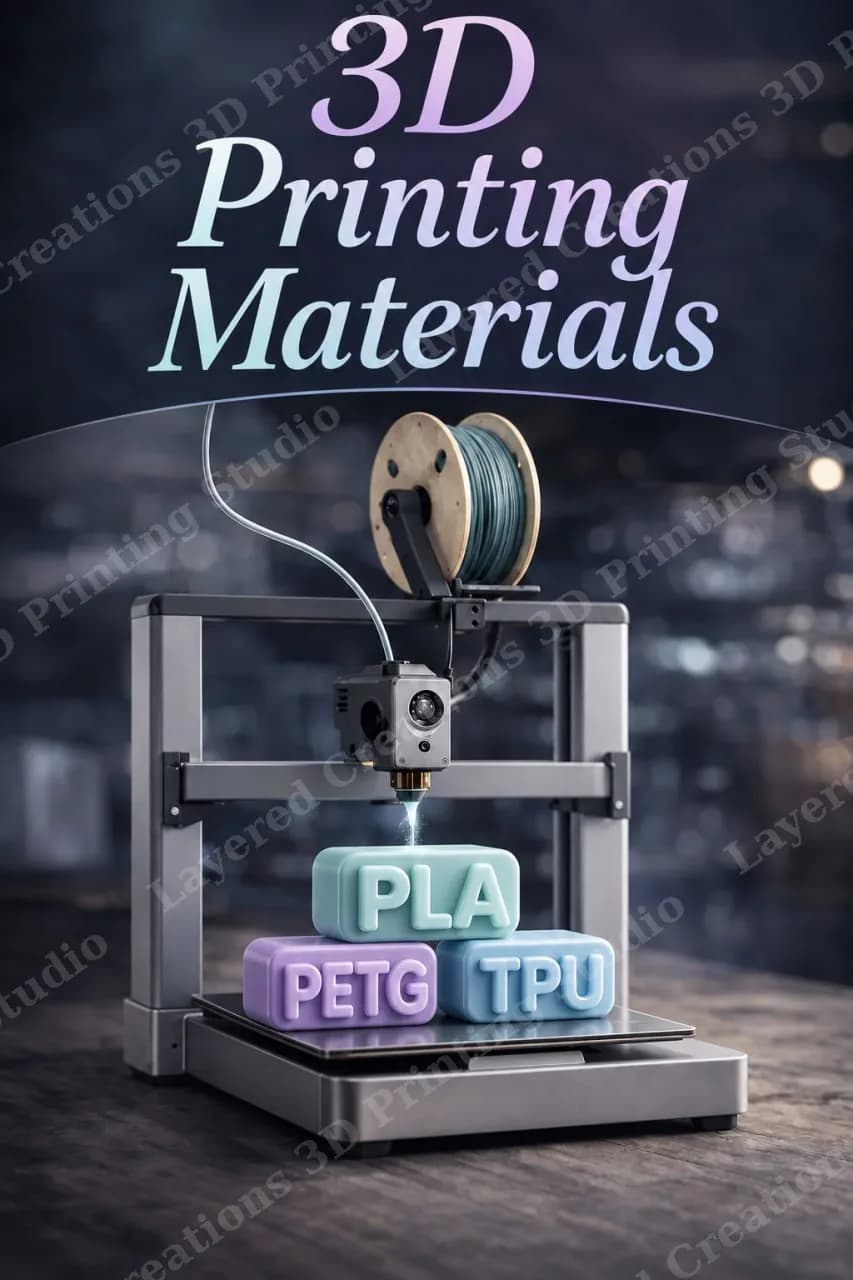
3D Printing has come a long way over the years and so has your material that you use to print with. Each material has its own characteristics, advantages and applications. From decorative home accessories to flexible components and even chocolate creations, the material you choose plays an important role in how your finished product looks, feels and functions.
At Layered Creations 3D printing studio, we believe that every creation begins with a story. Understanding the materials available helps us turn those stories into physical objects that are both beautiful and practical.
Let's explore some of the most common 3D printing materials and discover what makes each one unique.
We will dive into PLA (Polylactic Acid) first.
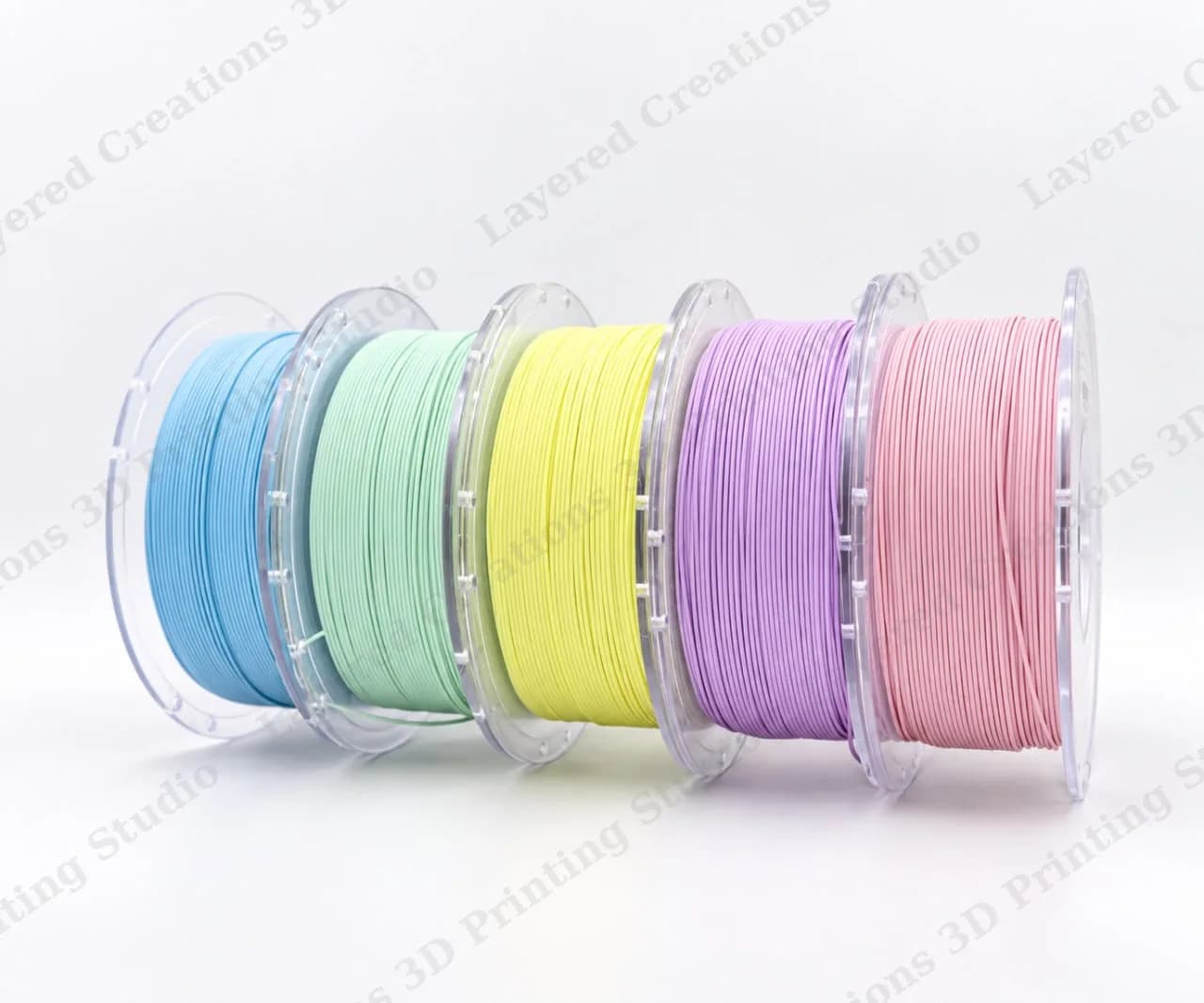
PLA is one of the most widely used materials in FDM (Fused Deposition Modelling) 3D printing.
It is made from renewable raw materials such as corn starch or sugarcane and is popular because it is relatively easy to print, produces detailed results and comes in an extraordinary range of colours and finishes.
PLA is particularly well suited to decorative and creative projects.
Common applications:
- Home décor and decorative accessories
- Figurines, sculptures and display pieces
- Personalised gifts
- Educational models and prototypes
- Dollhouse furniture and miniatures
PLA is available in a wide variety of finishes, including matte, silk, metallic-effect, translucent and colour-changing filaments.
These variations make it possible to create objects that look very different from one another, even though they are made from the same base material.
How does PLA handle heat?
One thing to keep in mind when working with PLA is that it does not handle high temperatures particularly well. When exposed to enough heat, PLA begins to soften and can lose its shape.
However, this can also be used to our advantage when creating certain designs.
For example, when we print our tulips at Layered Creations SA, the leaves are printed flat on the build plate. Once printed, we gently warm them with a hairdryer and carefully bend them to create a more natural, flowing shape.
This allows us to give each flower its own unique character.
The same principle means that finished PLA creations should be kept away from excessive heat, such as direct sunlight in a hot car or close proximity to heaters, as they may soften or warp.
Let’s dive into what PLA is…
From Plants to Plastic: What Is PLA Actually Made Of?
PLA, or polylactic acid, is one of the most commonly used materials in 3D printing. It is a plant-based plastic made from renewable resources such as corn starch and sugarcane.
But how do we get from a plant growing in a field to a neat roll of plastic filament?
The process is quite fascinating.
It all starts with sugar
The first step is extracting sugar from plants.
When corn is used, its starch is broken down into simple sugars using enzymes. Sugarcane follows a slightly different process, as the sugar can be extracted directly from the plant.
These sugars are then placed into large fermentation tanks, where microorganisms convert them into lactic acid.
This is where the transformation begins.
Turning lactic acid into plastic
The lactic acid is purified and put through a series of chemical processes.
First, it is converted into a molecule called lactide. These molecules are then joined together to form long chains through a process known as polymerisation.
The result is PLA: a thermoplastic that can be melted, shaped and solidified again.
The finished plastic is processed into small pellets, which are supplied to manufacturers around the world.
But we are not quite at the filament stage yet!
How does PLA become 3D printing filament?
The PLA pellets are first dried to remove moisture and then fed into an extrusion machine.
Inside the machine, the pellets are heated until they melt. The molten plastic is pushed through a small opening to form one continuous strand.
That strand is carefully cooled and pulled through a measuring system to ensure that it maintains a consistent diameter.
Most of the filament we use in our studio has a diameter of 1.75 mm.
Once the filament has cooled and passed its quality checks, it is wound onto a spool, packaged and ready for printing.
And there you have it. From a plant growing in a field to a roll of filament ready to create something new.
But what about all those beautiful colours?
PLA resin is naturally relatively clear, but filament manufacturers can add pigments to create the colours we see on the shelves.
They can also include other additives to change the plastic's properties, such as making it stronger, more flexible or easier to print.
This is why different PLA filaments can behave differently, even though they share the same basic material.
At Layered Creations SA, we work with different PLA colours and finishes, from soft translucent materials to vibrant colours, depending on what we are creating.
Is PLA biodegradable?
One of the interesting things about PLA is that it comes from renewable plant-based resources rather than relying entirely on fossil-derived raw materials.
PLA can also biodegrade under suitable conditions, particularly in industrial composting facilities.
However, that does not mean a finished 3D-printed object will simply disappear if you place it in your garden.
The conditions needed for PLA to break down are quite specific, and the additives used in commercial filament can also influence its composability.
So, while PLA offers an alternative to conventional fossil-based plastics, it is still important to understand how the finished material behaves.
Every creation begins with a story
The next time you see a roll of PLA filament, think about the journey it has taken.
From plants and sugar to fermentation, chemistry and precision manufacturing, an incredible amount of work goes into producing that single roll.
And at Layered Creations SA, that is where another story begins.
We take that filament, melt it once more, and transform it into something completely new, one layer at a time.
Next week, we’ll dive deeper into PETG as a 3D printing material.
Would you like to be notified when the next post goes live? Leave your email address below, and we’ll let you know!
Stay in the Loop
Would you like to be notified when the next post goes live? Leave your details below, and we’ll let you know!
Layered Creations
Every creation begins with a story.