2026-04-07
What Is 3D Printing? A Beginner's Guide to How It Works and Why It Matters
If you have ever wondered how an idea becomes a real object that you can hold in your hands, then you have already started asking the question that sits at the heart of 3D printing.
If you have ever wondered how an idea becomes a real object that you can hold in your hands, then you have already started asking the question that sits at the heart of 3D printing.
A design begins as an idea. It might be a decorative piece for a home, a personalised gift, a replacement part that can no longer be purchased, or a completely new creation that exists only in someone’s imagination. Through 3D printing, that idea can be transformed into a physical object, often within a matter of hours.
Over the last decade, 3D printing has moved from industrial factories and research laboratories into homes, schools, workshops, and small businesses around the world. What was once considered futuristic technology has become an accessible tool for creativity, problem-solving, manufacturing, and design.
But what exactly is 3D printing, and why has it become such an important technology?
What Is 3D Printing?
3D printing, also known as additive manufacturing, is the process of creating a three-dimensional object from a digital design by building it layer by layer.
Traditional manufacturing often involves cutting, drilling, carving, or moulding materials into shape. These methods either remove material or require expensive tooling and moulds.
3D printing works differently.
Instead of removing material, a 3D printer adds material only where it is needed. Thousands of thin layers are placed on top of one another until the final object is complete.
The layers are incredibly thin, often between 0.1 mm and 0.3 mm thick. To put that into perspective, a standard sheet of office paper is approximately 0.1 mm thick.
This layer-by-layer approach allows designers to create shapes and forms that would be difficult, expensive, or even impossible to manufacture using traditional methods.
How Does 3D Printing Work?
Every 3D printed object begins as a digital model.
The model may be designed from scratch using software such as Fusion 360, Blender, or Tinkercad, or it may be sourced from an online design library.
Once the design is complete, it is imported into a programme known as a slicer. The slicer converts the 3D model into hundreds or thousands of individual layers and generates a set of machine instructions known as G-code.
These instructions tell the printer: where to move, how fast to move, how much material to use, how hot the nozzle should be, and how each layer should be built.
The printer then follows those instructions precisely until the object is complete.
The Most Common Type of 3D Printing
The most widely used form of 3D printing today is called Fused Deposition Modelling (FDM). This is the technology used by most desktop printers and small businesses.
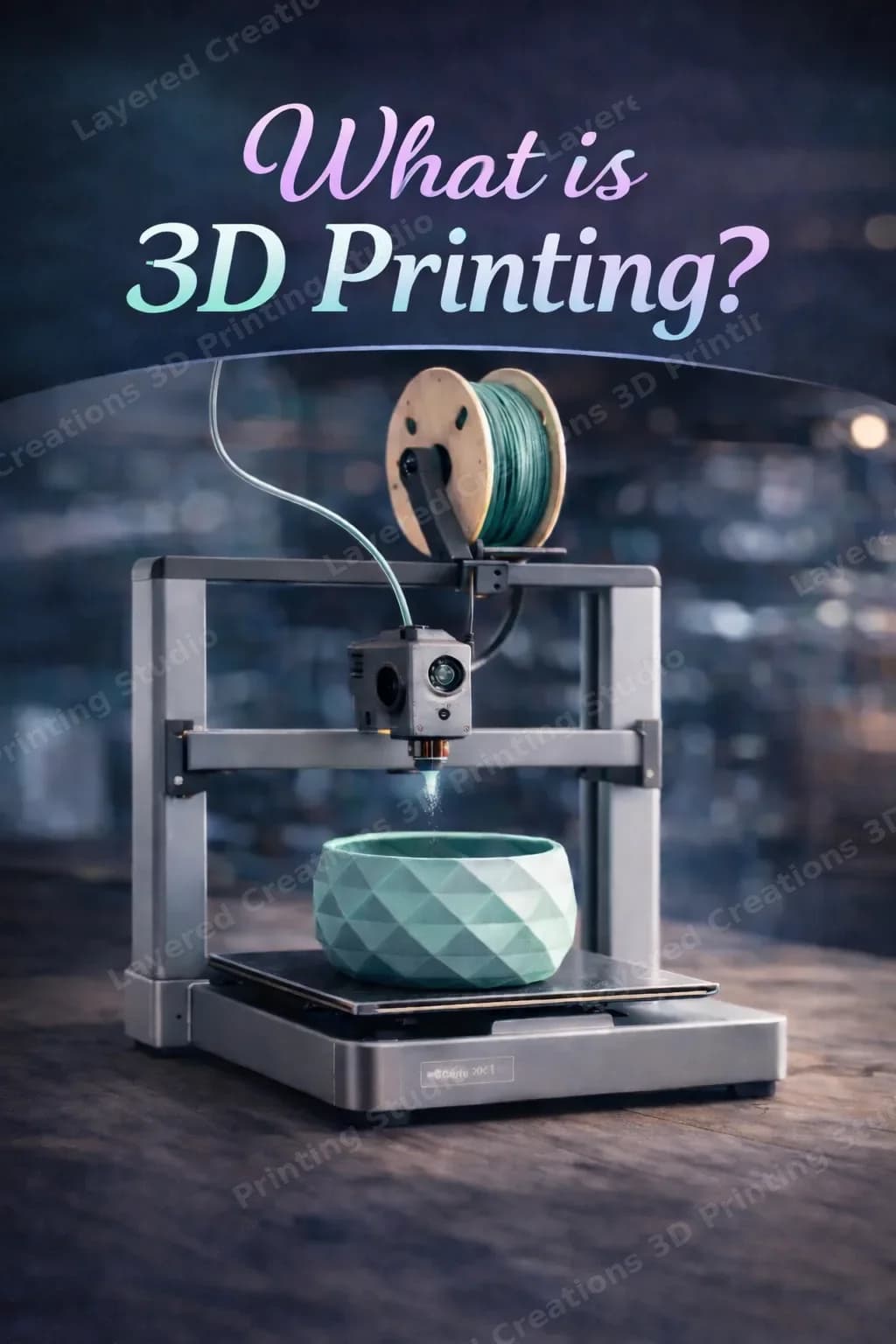
An FDM printer uses a spool of filament, which is a long strand of thermoplastic material. The filament is fed into a heated nozzle where it melts and is deposited onto a build plate.
The printer lays down one layer at a time. After a layer is completed, the printer moves slightly and begins building the next layer on top of it. This process continues until the object is finished.
What makes this technology remarkable is its simplicity. A digital idea can become a physical object without moulds, specialised tooling, or large-scale manufacturing equipment.
Why Is It Called Additive Manufacturing?
You may hear the term additive manufacturing used alongside 3D printing. The phrase simply describes the way the object is made.
Traditional manufacturing methods often remove material from a larger block. For example, a carpenter cuts wood away from a board, and a machinist removes metal from a solid piece of stock. This is known as subtractive manufacturing.
3D printing is additive because material is added only where required. The result is often less waste and greater design freedom.
This is one of the reasons the technology has attracted attention from industries ranging from aerospace and healthcare to architecture and product design.
What Materials Can Be Used?
One of the most exciting aspects of 3D printing is the variety of materials available.
PLA is one of the most widely used printing materials. It is easy to work with, available in hundreds of colours, and ideal for decorative items, gifts, models, and home décor.
PETG offers greater strength and durability while maintaining good print quality. It is often used for functional objects that require additional toughness.
ABS is known for its strength, durability, and heat resistance. It is commonly used in engineering and manufacturing applications.
TPU is a flexible material with rubber-like properties. It is used for products that need to bend without breaking.
ASA provides excellent UV resistance, making it suitable for outdoor applications.
Beyond plastics, industrial 3D printing systems can also work with metals, ceramics, composites, and specialised engineering materials.
What Can You Make With a 3D Printer?
This is often the question people ask first. The short answer is: far more than most people realise.
3D printing is used to create personalised gifts, home décor, custom signage, product prototypes, educational models, architectural models, business displays, replacement parts, event décor, organisational solutions, art and sculpture, medical models, and aerospace components.
In hospitals, surgeons use 3D printed anatomical models to prepare for complex procedures. In aerospace, companies use 3D printed components to reduce weight and improve efficiency. In homes and small businesses, creators use the technology to develop products that can be customised for individual customers.
A Brief History of 3D Printing
Although 3D printing feels like a modern invention, its origins stretch back more than forty years.
In 1984, Charles Hull developed stereolithography (SLA), one of the first successful 3D printing technologies. Hull later founded 3D Systems and helped establish many of the foundations of the modern industry.
In 1989, Scott Crump patented Fused Deposition Modelling (FDM), which became one of the most widely adopted forms of 3D printing worldwide.
For many years the technology remained expensive and was used primarily by large corporations. The major shift came during the 2000s when open-source initiatives such as the RepRap Project helped make 3D printing accessible to hobbyists, makers, educators, and small businesses.
As patents expired and technology improved, prices dropped dramatically while quality improved. Today, millions of people around the world have access to 3D printing technology.
Why 3D Printing Matters
The real value of 3D printing is not the machine itself. It is the freedom the technology creates.
Instead of being limited to mass-produced products, people can create objects that are designed for a specific purpose, person, or space. Need a replacement part that is no longer manufactured? Need a personalised gift? Need a prototype before investing in production? Need a unique decorative piece that cannot be found in stores?
3D printing makes these possibilities accessible. For creators, designers, and small businesses, it provides the ability to turn ideas into reality without the barriers traditionally associated with manufacturing.
How We Use 3D Printing at Layered Creations
At Layered Creations, 3D printing is one of the tools we use to transform ideas into meaningful creations.
From home décor and personalised gifts to custom projects and unique designs, the technology allows us to explore creative possibilities that would often be difficult to achieve through traditional manufacturing methods.
For us, it is not about the printer. It is about what can be created with it.
because every creation begins with a story...
Stay in the Loop
Would you like to be notified when the next post goes live? Leave your details below, and we’ll let you know!
Layered Creations
Every creation begins with a story.